Binary Number System
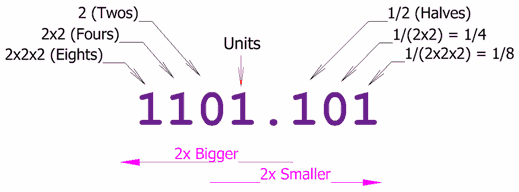 |
| This is 1×8 + 1×4 + 0×2 + 1 + 1×(1/2) + 0×(1/4) + 1×(1/8) (=13.625 in Decimal) |
Similar to the Decimal System, numbers can be placed to the left or right of the point, to indicate values greater than one or less than one. For Binary Numbers:
 | The number just to the left of the point is a whole number, we call this place units. As we move left, every number place gets 2 times bigger. |
 | The first digit on the right of the point means halves (1/2). As we move further right, every number place gets 2 times smaller (one half as big). |
2 Different Values
Because you can only have 0s or 1s, this is how you count using Binary:
| Decimal: | 0 | 1 | 2 | 3 | 4 | 5 | 6 | 7 | 8 | 9 | 10 | 11 | 12 | 13 | 14 | 15 |
|---|---|---|---|---|---|---|---|---|---|---|---|---|---|---|---|---|
| Binary: | 0 | 1 | 10 | 11 | 100 | 101 | 110 | 111 | 1000 | 1001 | 1010 | 1011 | 1100 | 1101 | 1110 | 1111 |
"Binary is as easy as 1, 10, 11."
Here are some more equivalent values:
| Decimal: | 20 | 25 | 30 | 40 | 50 | 100 | 200 | 500 |
|---|---|---|---|---|---|---|---|---|
| Binary: | 10100 | 11001 | 11110 | 101000 | 110010 | 1100100 | 11001000 | 111110100 |
Definition of Binary
 | The word binary comes from "Bi-" meaning two. We see "bi-" in words such as "bicycle" (two wheels) or "binocular" (two eyes). |
 | When you say a binary number, pronounce each digit (example, the binary number "101" is spoken as "one zero one", or sometimes "one-oh-one"). This way people don't get confused with the decimal number. |
Bits
A single binary digit (like "0" or "1") is called a "bit". For example 11010 is five bits long.
The word bit is made up from the words "binary digit"
How to Show that a Number is Binary
To show that a number is a binary number, follow it with a little 2 like this: 1012
This way people won't think it is the decimal number "101" (one hundred and one).
Examples
Example 1: What is 11112 in Decimal?
- The "1" on the left is in the "2×2×2" position, so that means 1×2×2×2 (=8)
- The next "1" is in the "2×2" position, so that means 1×2×2 (=4)
- The next "1" is in the "2" position, so that means 1×2 (=2)
- The last "1" is in the units position, so that means 1
- Answer: 1111 = 8+4+2+1 = 15 in Decimal
Example 2: What is 10012 in Decimal?
- The "1" on the left is in the "2×2×2" position, so that means 1×2×2×2 (=8)
- The "0" is in the "2×2" position, so that means 0×2×2 (=0)
- The next "0" is in the "2" position, so that means 0×2 (=0)
- The last "1" is in the units position, so that means 1
- Answer: 1001 = 8+0+0+1 = 9 in Decimal
Example 3: What is 1.12 in Decimal?
- The "1" on the left side is in the units position, so that means 1.
- The 1 on the right side is in the "halves" position, so that means 1×(1/2)
- So, 1.1 is "1 and 1 half" = 1.5 in Decimal
Example 4: What is 10.112 in Decimal?
- The "1" is in the "2" position, so that means 1×2 (=2)
- The "0" is in the units position, so that means 0
- The "1" on the right of the point is in the "halves" position, so that means 1×(1/2)
- The last "1" on the right side is in the "quarters" position, so that means 1×(1/4)
- So, 10.11 is 2+0+1/2+1/4 = 2.75 in Decimal
"There are 10 kinds of people in the world,
those who understand binary numbers, and those who don't."

No comments:
Post a Comment